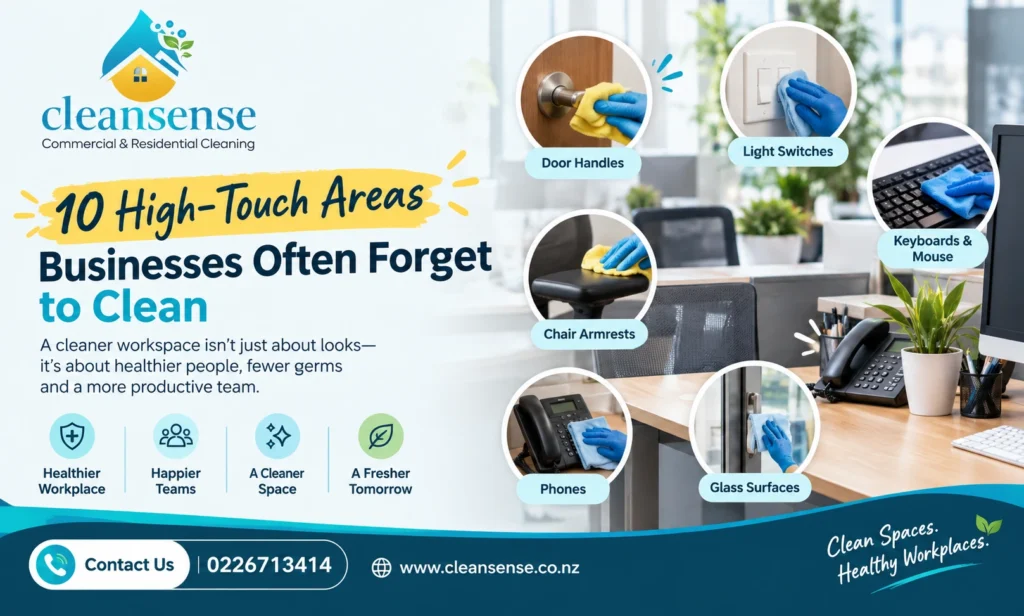
High-touch spots in a workplace are the places people touch with their hands again and again. Think of door knobs, light switches, shared machines, and any tools used by more than one person each day. Since these items get handled so much, germs can build up much faster there than on open floor areas or on some pieces of furniture. Still, regular General cleaning plans often leave these spots out. Schedules may focus on floors, desks, and bathrooms instead.
For businesses in Auckland, this matters in a practical way. It can mean the difference between a place that only looks tidy and a place that is truly kept clean. Offices, shops, schools, kindergartens, and job sites all face the same problem. Below are ten high-touch areas that are commonly overlooked, plus why they matter and what you can do to keep them in check.
Why High-Touch Cleaning Matters More Than Ever
Workplace hygiene studies keep showing the same pattern: germs spread quickly after they land on shared items. A University of Arizona report that gets cited a lot found that about half of the usual “high touch” spots in an office picked up a virus by mid day. This happened after only one ill worker came in.
Other checks point to how messy desks can get. A typical desk can hold about 20,000 germs in every square inch. That is close to 400 times more than what people find on a toilet seat. The worst offenders often include elevator button panels, coffee machine handles, fridge door pulls, kitchen taps, restroom door handles, computer keyboards, phones, and printer controls.
For businesses in Auckland, these findings matter in day to day terms. When people take sick days, work slows down. Places clients see can also shape how a business is viewed. In settings like childcare and schools, where rules apply, hygiene cannot be treated as optional. If a cleaning schedule only targets low use areas, it can leave out the surfaces that spread trouble fastest.
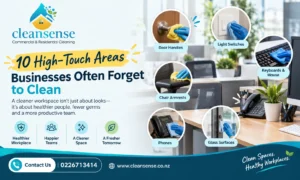
The 10 High-Touch Areas Most Businesses Miss
1. Door Handles, Push Plates and Handrails
Every person entering or leaving a room touches the same handle, often without washing their hands first or after. Front entrances, meeting room doors, and fire exits are used dozens or hundreds of times a day, yet handles are frequently wiped only during a general dust-down rather than disinfected. A daily wipe-down with a proper disinfectant, not just a dry cloth, should be standard for any commercial cleaning services Auckland business relies on.
2. Light Switches and Switch Plates
Light switches get handled a lot. You see them the moment you walk in, so almost everyone touches them. Still, many people forget to wipe them. They are small, and they are often not in your direct view when you clean.
Some research reports that switches can have less buildup than desks or phones. The idea is that you only press them for a moment. But “less contaminated” does not mean “clean.” They should still be included in any cleaning checklist.
3. Elevator and Vending Machine Buttons
In multi-storey office buildings, elevator buttons are pressed by every visitor and staff member, often with the same finger used moments later to eat a snack or rub an eye. Vending machine buttons and touchscreens carry the same risk. These small, plastic surfaces are easy to disinfect but easy to forget precisely because they’re not part of a “surface” in the traditional sense.
4. Reception Desks, Countertops and Sign-in Tablets
Reception areas are a business’s first impression, but they’re also a hygiene bottleneck: visitors lean on the counter, sign in on shared tablets or pens, and staff handle deliveries, mail, and packages across the same surface all day. A visibly clean but rarely disinfected reception desk undermines the professional image a business is trying to project.
5. Staff Kitchen Appliances Including Ovens and Microwaves
Break rooms and staff kitchens are used by everyone in the building. People touch fridge doors, microwave buttons, and kettle handles all day, often without washing their hands first.
Ovens need extra care. Grease and bits of food can stick inside the oven cavity. They also collect along door seals and near the control panel. A fast wipe usually does not reach these spots.
That is why professional oven cleaning Auckland matters. Baked-on grease is not just dirty. It can raise the chance of a fire. It can also cause smoke and bad smells that do not go away with a quick clean.
Cleansense offers deep appliance cleaning as part of its commercial and home cleaning services in Auckland. Ovens are treated the same way as floors and bench surfaces.
6. Bathroom Taps, Flush Buttons and Dispensers
Bathrooms usually get cleaned regularly, but the specific touch points inside them tap handles, flush buttons, soap and paper towel dispensers, and door locks need separate, frequent disinfection rather than a single end-of-day wipe. These are also the surfaces most likely to be touched immediately before or after hand contact with the face.
7. Shared Office Equipment: Keyboards, Phones, Printers
Hot-desking lets more than one person use the same work setup in the same day. That can include the keyboard, mouse, phone handset, and the screen on a printer or photocopier.
A Clorox funded study looked at office germs. It listed phones first, then desks, then keyboards, and then computer mice.
If a company uses shared or flexible seating, it should make cleaning a top priority. This should not be something they do only later or after other tasks are done.
8. Stairwell and Corridor Handrails
Handrails are gripped tightly, often by several people in quick succession, and rarely feature on standard cleaning checklists because they’re considered part of “the building” rather than a workspace. In multi-level offices, retail centres, and schools, they should be treated the same as door handles.
9. Hard Floors Near Entrances and High-Traffic Zones
Floors do not count as the first “touch” in a strict sense. Still, entrance mats, threshold strips, and the first stretch of hard flooring take in the worst of what comes in from outside. That includes dirt, wet spots, and other grit that people track in. People also brush their hands on nearby rails, trolley handles, or door frames while moving through these areas.
When you clean hard floors in Auckland the right way, you help with hygiene and you also help the floor last longer. The steps should match the surface, whether it is tile, vinyl, timber, or polished concrete.
This point gets even more serious at industrial sites. There, a floor cleaning team has to deal with oil, dust, and constant movement from feet and forklifts. They must do it without harming the top layer of the flooring.
10. Childcare and Kindergarten Toys, Furniture and Play Surfaces
In early childhood settings, almost everything is a high-touch surface toys, table edges, cot rails, door handles at child height, and shared art supplies. Children have less developed hand hygiene habits and more frequent hand-to-mouth contact, which makes kindergarten cleaning services Auckland providers rely on especially rigorous. Childcare cleaning services and broader education sector cleaning need daily disinfection protocols that go well beyond a standard office clean, covering low-level surfaces, soft furnishings, and shared equipment that adult-focused cleaning routines often miss entirely.
Industry Trends Shaping Commercial Cleaning in Auckland
Workplace hygiene expectations have shifted permanently since 2020, and a few trends are shaping how Auckland businesses approach cleaning contracts in 2026:
- Touchpoint-specific scheduling. Rather than a single “clean the office” task, more businesses now specify touch point disinfection as a separate, more frequent line item in their cleaning contracts.
- Post-construction and builders cleaning demand. With ongoing commercial fit-outs and residential builds across Auckland, construction cleaning Auckland and builders cleaning Auckland services are increasingly bundled with final handover inspections, covering dust, debris, and surface residue before a space is occupied.
- Sector-specific protocols. Education and childcare cleaning now commonly follow documented protocols rather than general commercial cleaning standards, reflecting stricter expectations from parents, regulators, and school boards.
- Floor care as asset protection. Businesses are treating hard floor and industrial floor cleaning as maintenance investment rather than a cosmetic task, since correct methods extend the life of expensive flooring and reduce slip risk.
- Demand for a single accountable provider. Rather than juggling separate contractors for office cleaning, appliance cleaning, and floor care, many Auckland businesses now prefer one cleaning company sensational cleaning services that cover the full scope from daily touch point wipe-downs to periodic deep cleans like oven servicing.
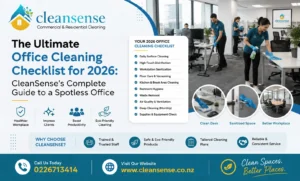
A Simple High-Touch Cleaning Checklist
| Area | Recommended Frequency | Method |
| Door handles, handrails | Daily (multiple times in shared spaces) | Disinfectant wipe or spray |
| Light switches | Daily | Disinfectant wipe |
| Elevator/vending buttons | Daily | Disinfectant wipe |
| Reception desk, tablets | Daily, more in high-traffic sites | Disinfectant spray + microfibre cloth |
| Kitchen appliances, ovens | Weekly wipe-down; deep clean quarterly | Degreaser, professional deep clean for ovens |
| Bathroom taps, dispensers | Multiple times daily | Disinfectant spray |
| Keyboards, phones, printers | Daily | Alcohol-based wipe |
| Stairwell rails | Daily | Disinfectant wipe |
| Entrance floors | Daily sweep/mop; periodic deep clean | Method matched to floor type |
| Childcare toys, surfaces | Daily, after each use where possible | Child-safe disinfectant |
Frequently Asked Questions
What counts as a “high-touch surface”?
A high-touch surface is any point that multiple people touch repeatedly throughout the day door handles, light switches, shared equipment, and appliance controls are the clearest examples. These surfaces accumulate bacteria and viruses faster than surfaces touched only occasionally, which is why they need more frequent attention than a standard weekly clean provides.
How often should high-touch surfaces be disinfected?
Most high-traffic touch points door handles, bathroom fixtures, shared keyboards benefit from daily disinfection at minimum, with busier sites like reception desks or childcare centres needing multiple passes per day. Lower-traffic touch points like light switches can be cleaned less frequently but shouldn’t be skipped entirely.
Why does oven cleaning need to be professional rather than DIY?
Baked-on grease and carbonised residue build up inside oven cavities and around door seals in ways a household cleaner or general wipe down can’t fully remove. Professional oven cleaning uses stronger, purpose-built products and tools to strip build-up safely without damaging heating elements or seals, which also reduces fire risk and smoke or odour during use.
Do kindergartens and schools need different cleaning standards to offices?
Yes. Children have more frequent hand-to-mouth contact and less developed hygiene habits, so early childhood and education settings typically require daily disinfection of low-level surfaces, toys, and shared equipment, a stricter standard than most office cleaning protocols.
What’s the difference between builders cleaning and regular commercial cleaning?
Builders cleaning (sometimes called post-construction cleaning) addresses dust, debris, adhesive residue, and paint or plaster over spray left after a build or renovation, before a space is fit for occupation. Regular commercial cleaning is ongoing maintenance of an already-finished space and doesn’t involve the heavy-duty debris removal a construction handover requires.
How does industrial floor cleaning differ from standard hard floor cleaning?
Industrial floors typically deal with oil, grease, chemical spills, and heavy machinery or forklift traffic, requiring specialised equipment, degreasers, and sometimes floor sealing or coating maintenance. Standard hard floor cleaning for offices or retail spaces focuses more on foot traffic, dust, and surface polish rather than industrial contamination.
Can one cleaning company realistically cover offices, construction sites, and childcare centres?
Yes, provided the company maintains sector-specific protocols and trained staff for each environment. A single provider managing house cleaning, commercial cleaning, construction cleaning, and childcare cleaning under one contract also simplifies scheduling and quality control compared to using separate specialists for each.
What’s a quick way to audit whether high-touch cleaning is being done properly?
Walk through the space and physically check the ten areas above door handles, switches, shared equipment, appliance handles, and bathroom fixtures for visible residue or grime rather than relying on a completed checklist alone. If a cleaning report says an area was done but it still looks or feels untouched, it’s worth raising directly with the provider.